At the start of the year, I began my first experiments with casting glass in my pottery kiln. It was not very successful, but I wanted to try again. I have recently finished my second attempt and had much better results!
I thought that I would take you through the process.
I began with deciding what to make. I have chosen to make some rabbits. Last year, we got a pet rabbit, who is quite cute and he was the inspiration and model for these pieces.

The next step is to make the model. I used a special model making clay which is more dense and malleable than regular clay.
In my first attempt at glass casting, I had trouble getting the clay model out of the mould, so this time, I made sure that the base of the model was wider to allow me to remove the clay.
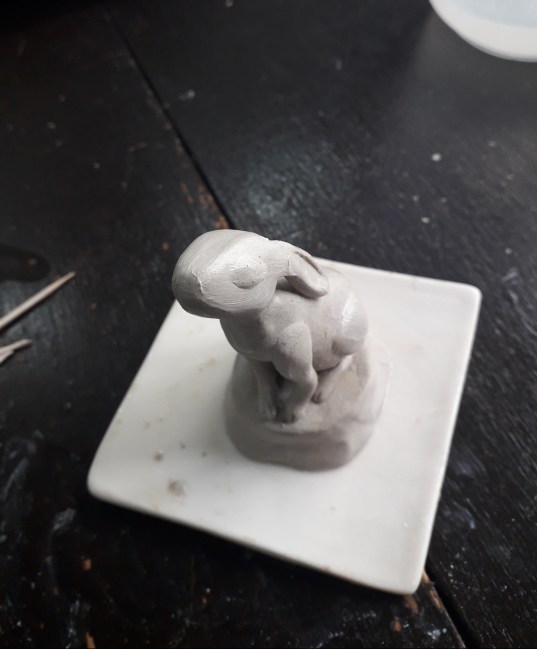
Once the model is finished, the next step is to create a plaster mould. The plaster is what will go into the kiln. I’ve become quite familiar with the plaster used in pottery but glass casting plaster is much more dense.

The moulds are left to dry for at least a week. If there is any moisture left, it can cause inclusions in the glass.
Once the moulds are dry, I calculate how much glass is needed to fill them. For these I have used a broken vase that I rescued from the bin. I smashed it up further to fit in the moulds.
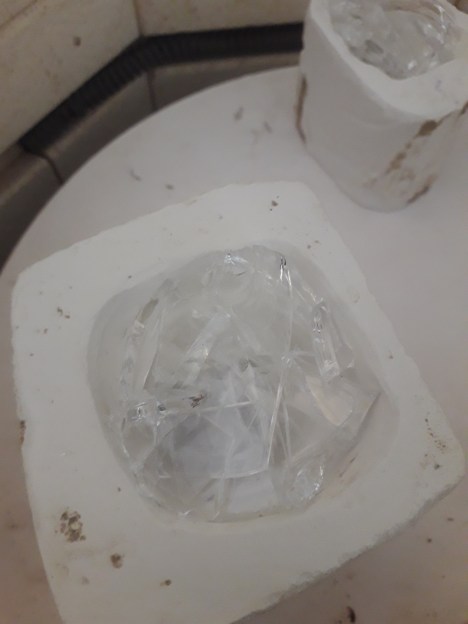
The moulds are then put in the kiln and heated up to 823*C. In pottery I am used to leaving the kiln to cool on it’s own, but because of the nature of glass, the kiln has to perform a cooling cycle and cool much more slowly.
Once the pieces are cool enough, I have to remove the glass from the plaster. I feel a bit like an archaeologist!

Eventually, the pieces are out and I can inspect my efforts!
![20200902_110359[1]](https://karenspring.art/wp-content/uploads/2020/09/20200902_1103591-e1599041412603.jpg?w=615&h=447)
![20200902_111411[1]](https://karenspring.art/wp-content/uploads/2020/09/20200902_1114111.jpg?w=491&h=656)
 Spring